
Do people trust AI?
It depends...

Trust varies by geography, age, income, sector, occupation and (to a lesser extent) gender and political orientation.
For instance, people in what are sometimes called ‘emerging market economies’ (China, Brazil, Kenya and India) are markedly more optimistic and trusting of AI than those in the US, UK, and parts of Western Europe.
But even that overview belies significant differences. In Europe, the citizens of Norway, Switzerland, and Latvia have relatively high AI trust compared to, say the UK, and many Central European countries.
In the US, public apprehension about AI exceeds enthusiasm, with about 30 to 35% trusting AI (compared with 50 to 60%+ in those emerging markets).
But, again, the devil is in the detail. Within individual countries, younger adults are consistently more trusting of AI than older cohorts. Higher‑income groups typically express more trust, and men tend to be slightly more trusting than women, although that gap is modest.
Trust is higher among workers in tech, finance, and professional services, and lower among those in healthcare, education, and public‑facing roles, for instance.
Trust vs task
‘Trust in AI’ is itself a pretty clumsy term, because trust differs depending on what we are asking AI to do.
People trust AI more for low‑risk, computational tasks like data sorting, logistics, memory recall and far less for high‑stakes decisions such as healthcare diagnoses, autonomous‑vehicle control, or use in the criminal justice system. (Where, by the way, algorithmic decision making has been deployed – not without controversy - for over two decades.)
The mis-attribution of trust
As we discuss in our book ‘AI for PR’, Rachel Botsman, author of two best-selling books on trust, suggests that ‘the danger isn’t just too much or too little trust’ in AI. “It’s misplaced trust - and that’s where real harm happens….The most dangerous systems aren’t always the least trustworthy – they’re the ones we trust too much[1].”
This mis-attribution of trust has quite considerable reputational consequences for organisations. When an employee falls for an AI-generated deepfake that has been engineered to create a data breach, for instance. When AI users become over-confident or over-reliant on the large language model and the human in the loop is quietly forgotten, with potentially serious consequences for accuracy and, ultimately, trust in the organisation. When a team refuses to deploy AI or sabotages an AI project.
Our views are weird
Another reason ‘do people trust AI?’ is a suboptimal question is that it suggests that our views on AI might be settled, reasonable, consistent and rational. They are not.
We use AI frequently while distrusting it, we overestimate our ability to spot AI content, and we commonly support AI in abstract but resist it when it touches personal outcomes. There is a longstanding trend in research for respondents to say they are concerned about AI’s impact on jobs in their sector but to earnestly consider that it won’t be their job that’s affected.
One of the starkest demonstrations of just how ‘weird’ (by which I mean out of whack with the evidence or inconsistent or inexplicable) our views are on AI comes from the excellent ‘How do people feel about AI?’ study (a much better question than ‘Do people trust AI?’) published by the Ada Lovelace and Alan Turing Institutes[2].
In that study respondents consider that robotic vacuum cleaners are more beneficial than robotic care assistants and, despite huge issues with bias in the field, the use of AI for facial recognition in policing is ranked as highly beneficial.
Varied and changing views on AI are to be expected. This is a new, revolutionary general technology that is developing at speed. It’s difficult for well-informed users of AI to keep up, never mind less interested non-users, for instance.
What does this mean for the PR function?
Organisations deploying AI need to understand how their stakeholders feel about it. Secondary research is a useful first step. But it comes with the usual challenges.
Anthropic’s 81,000 person study on attitudes to AI, for instance, contains some fascinating data, including insights on what people most worry about[3].
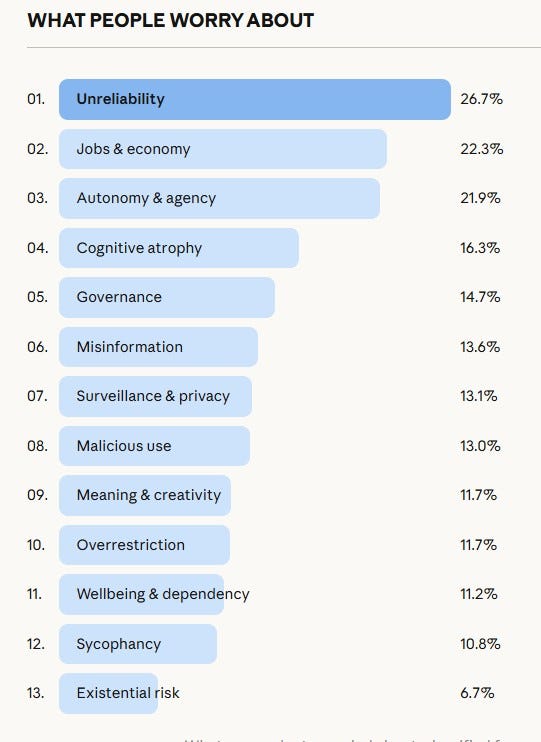
But this is a weighted study, conducted among users of Anthropic’s product Claude. It’s not representative of a broader public.
Nor is it likely to be representative of any organisation’s own stakeholders.
Which is why, ultimately, the PR function should be undertaking primary research on its behalf.
Further reading
Edelman (2025) 2025 Edelman Trust Barometer. Edelman, January
Just Capital (2026) New research reveals how public expectations on AI are shifting, Just Capital, 12 April
KPMG and University of Melbourne (2025) Trust, attitudes and use of artificial intelligence: A global study 2025, KPMG International, April
McKinsey and Company (2026) State of AI trust in 2026: Shifting to the agentic era, McKinsey and Company, 24 March
Nesta and Opinium (2025) Less than half of the UK public trust the public sector to use AI responsibly, Nesta, 1 December
Stanford Institute for Human-Centered Artificial Intelligence (2026) Public opinion | The 2026 AI Index Report, Stanford HAI
[1] Botsman, A (2025) ‘I’m being asked A LOT of questions about trust in AI, LinkedIn, 23 May
[2] Ada Lovelace Institute and The Alan Turing Institute (2025) How do people feel about AI?, March
[3] Huang, S. et al. (2026) ‘What 81,000 people want from AI’, Anthropic, 18 March